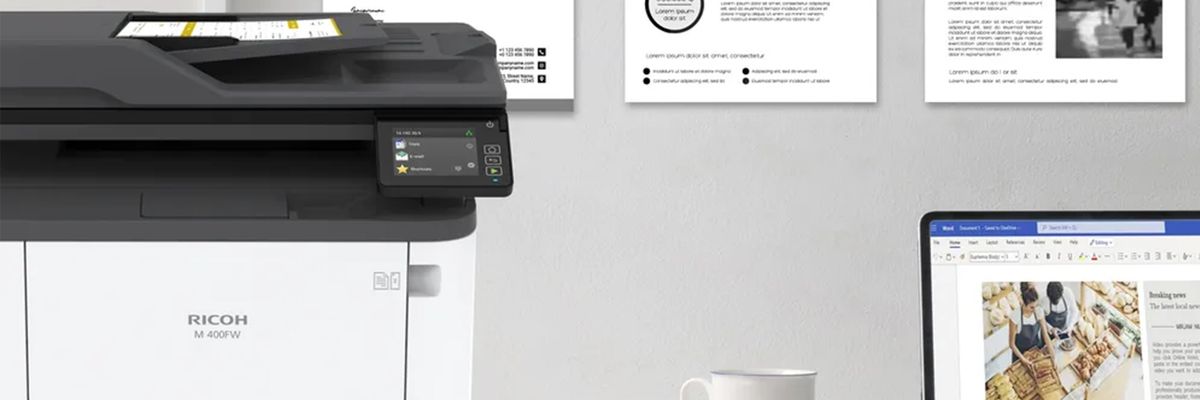


Ricoh: a Technology Integrator for the Workplace
Discover how Ricoh is evolving as a technology integrator, connecting processes, spaces and IT solutions to transform business workplaces.
The adoption of generative artificial intelligence and other emerging technologies is accelerating. However, completing individual tasks faster does not necessarily translate into better results for the business as a whole. To achieve this, organizations need to examine their complex, interconnected processes and transform people, processes, data, technology and work environments together. Otherwise, the benefits will remain limited to isolated efficiency improvements.
In this context, having a technology services integrator that connects IT solutions, business processes and work environments is becoming increasingly relevant for organizations seeking to turn operational efficiency into business results.
In its Mid-Term Management Strategy ’26, announced in March 2026, Ricoh presented its vision of becoming a leading global workplace integrator. To achieve this, it aims to connect its customers’ work, spaces and knowledge, helping them strengthen their competitive advantage and differentiate themselves in the market.
Why does Ricoh, a company recognized for decades for its printers and multifunction devices, now aspire to become a workplace integrator? To find out, we spoke with Kazunori Kobayashi, Chief Marketing Officer (CMO) of Ricoh Company, Ltd. and head of the Integration Marketing Division.
From productivity to business results through technology integration
Generative artificial intelligence is already changing the way people work. Today, many are seeing tasks that once took hours completed in a matter of minutes. However, business processes are complex and interconnected. Some tasks take place within applications, others depend on human judgment, and many involve different departments. As a result, improvements in individual productivity do not automatically translate into better outcomes for the entire organization.
“On a production line, improving one process does not increase overall productivity if bottlenecks remain at other stages. The same applies to business. Rather than treating AI adoption as an end in itself, companies need to look at the business as a whole, identify where and how change can be generated, and define the outcomes they want to achieve,” says Kobayashi.
The executive identifies four essential elements for turning technology into business results:
Approach the initiative as a business transformation, not simply as a technology implementation.
Start with the desired outcomes, such as revenue growth, profitability and customer value, rather than focusing solely on saving time on individual tasks.
Understand business processes from end to end and identify where AI can make an impact.
Ensure that data is reliable and usable, and establish a foundation that supports stable operations while ensuring security and governance.
“Many companies rush to adopt new technologies, experiment with different use cases and then fail to achieve significant results because they lack an end-to-end design. When a new technology emerges, they repeat the same cycle. I have seen this happen many times,” he says.
Breaking that cycle requires more than selecting products or tools. Organizations need partners who understand the business as a whole and can design and operate solutions until they deliver tangible results.
From technology provider to workplace integrator: Ricoh’s evolution
For decades, Ricoh has supported people in their work through a wide range of products and services that go far beyond multifunction printers. In 2020, the company declared its commitment to becoming a digital services company and has progressively expanded its business areas ever since.
Becoming a workplace integrator represents the next stage of that transformation. The term “integrator” more clearly expresses both what Ricoh is already doing and the direction it has chosen to pursue.
For Ricoh, integration goes beyond combining products and services. It means connecting technologies, business processes, work environments and specialized expertise to address each customer’s specific challenges and deliver tangible business results.
It also means combining Ricoh’s own technologies and services with those of external partners to develop the most suitable solution for each organization.
Ricoh’s approach focuses on connecting three essential elements of the workplace: work, spaces and knowledge.
Connecting work: By linking people, data and AI with business processes, Ricoh seeks to optimize workflows from end to end, rather than limiting its efforts to improving the efficiency of individual tasks.
Connecting spaces: Ricoh seamlessly connects offices, frontline workspaces and remote locations to create environments where people can collaborate naturally and effectively, both with one another and with AI.
Connecting knowledge: Ricoh helps organizations turn individual experience and the specialized knowledge held by each department into knowledge shared across the organization through the use of data and AI. This makes it possible to generate value continuously.
“Our customers’ work, spaces and knowledge do not exist in isolation. Our goal is to connect these elements and create the optimal work environment for each customer. That is the kind of workplace integrator we aspire to be,” says Kobayashi.
However, connecting these elements just once is not enough. As the business environment changes, the way people work also evolves. Technological advances transform where people work and how they interact with AI, while the knowledge companies accumulate continues to grow.
“Our customers’ businesses and ways of working continue to change, just as technology does. That is why we must also keep pace with these changes, reconnect whatever is necessary at each stage and work alongside our customers until they achieve their desired outcomes. That is the value Ricoh delivers.”
Workplace expertise and trust built through relationships with 1.4 million customers
The foundation of Ricoh’s role as a workplace integrator lies in its relationships with approximately 1.4 million customers worldwide. For decades, Ricoh has worked closely with organizations in offices and other workplaces, gaining an in-depth understanding of how day-to-day business activities actually take place.
Over the years, the company has also developed a broad range of technologies through its multifunction device business and other areas. These include software, printing, optics and image processing, environmental technologies, production, analysis and control, materials and devices, and security.
According to Kobayashi, the combination of these technological capabilities and a deep understanding of workplaces is what sets Ricoh apart.
But for Kobayashi, something else is even more important: the trust Ricoh has built through long-standing customer relationships.
“Customers often tell us that they know they can count on Ricoh, that we do not walk away from projects and that we are committed to seeing them through to completion. We can work alongside our customers today because our founder and those who came before us built that trust and passed it on to us. That is the foundation of everything,” says Kobayashi.
Trust often becomes the starting point for new conversations. One example is a global manufacturer that began working with Ricoh around 2014–2015, when Kobayashi was based in Europe.
The relationship began with printers and multifunction devices. For more than a decade, Ricoh addressed the customer’s operational issues and complex requirements one by one, while providing reliable operations and maintenance services. Over time, the customer began asking Ricoh for help with matters that were no longer related to printers.
The company’s challenge was to consolidate the providers operating across different countries and regions and ensure that security standards, operating policies and service quality were consistent worldwide.
Ricoh made this integration possible through its service delivery and support capabilities in approximately 200 countries and regions, together with specialized global teams. Today, Ricoh’s support also includes AV Managed Services for meeting rooms across the customer’s global operations.
This example illustrates what working alongside customers means to Ricoh. It is not simply about maintaining the same services over time, but about understanding how customers’ businesses and ways of working evolve, and continuously adapting the value Ricoh delivers to meet their changing needs.
At the same time, global companies often have two expectations that can be in tension: maintaining consistent service quality worldwide and having solutions tailored to each customer’s specific local requirements.
For example, among multinational companies operating in France, some expect support in English, while others require assistance in French. Ricoh responds by assigning on-site personnel with the language skills needed to serve each customer. In some countries and regions, it also provides applications adapted to the specific requirements of each local market.
“Locally rooted services account for most of our business. On the other hand, global companies want to receive the same services, with the same quality, at all their locations, both in Japan and abroad. We have the ability to respond precisely to local needs while delivering consistent value globally. We know how to apply each approach as appropriate. That is our strength,” says Kobayashi.
One RICOH: integrating technology solutions and global knowledge
To make the most of these strengths, in April 2026 Ricoh introduced a new management structure designed to enable more agile collaboration across regions and businesses. The goal is to combine the customer knowledge developed by each region with the products, technologies and services of each business to create greater value for customers.
However, the greater the autonomy of each organization, the greater the risk that regions and businesses will optimize their operations separately rather than for the benefit of the Group as a whole.
To generate the greatest possible value across the organization, Ricoh introduced the concept of One RICOH.
“One RICOH does not mean consolidating everything into a single organization. It is about connecting the strengths of each region and business, reducing duplication and working together as the Ricoh Group to create the best solutions for customers,” says Kobayashi.
The Integration Marketing Division, which Kobayashi leads, plays precisely this connecting role. The division brings together regions, businesses, people, technologies and knowledge gained through customer interactions. It also engages external partners when necessary to develop the most suitable solution for each organization.
To connect customers’ work, spaces and knowledge, Ricoh must first connect its own regions, businesses, technologies and specialized expertise. One RICOH is also the foundation that makes this possible.
At the heart of Ricoh’s corporate philosophy is the Spirit of the Three Loves—“Love your neighbor, love your country, love your work”—promoted by its founder, Kiyoshi Ichimura.
Today, that legacy remains present in the company’s Mission and Vision, Fulfillment through Work. By staying close to people in their work and continuously driving transformation, Ricoh seeks to help unleash human creativity and build a sustainable future.
“When customers want to make even a small change to the way they work, I want Ricoh to be the first company they think of. Increasing, one company at a time, the number of customers who see us that way, through our track record and the trust we build, is a goal for Ricoh and for me personally,” says Kobayashi.
One principle that has guided Kobayashi in leading his organization is “TRUST and PRiDE.” It emerged from a workshop held in 2013, when he and his colleagues involved in solution development reflected on the kind of team they wanted to be.
One of the ideas that emerged was the desire to take pride in their work. But what would make that pride possible? Through further discussion, they reached a shared conclusion: pride comes from contributing to others and earning their trust.
“Only when you achieve results through your work, contribute to others and earn their trust can you feel truly proud of what you do. That is why TRUST comes before PRiDE. I always ask myself whether my words and actions live up to the trust others place in me,” says Kobayashi.
As technologies such as AI continue to evolve rapidly, companies need more than the adoption of individual tools: they need to turn change into meaningful business results.
Ricoh understands its customers’ workplaces and connects their work, spaces and knowledge. By bringing together the right technologies and services, both its own and those of third parties, it works alongside customers until they achieve their expected results.
This work never ends. As customers’ businesses and ways of working evolve, so do the needs of their workplaces and the value Ricoh must deliver.
By continuously adapting to these changes and bringing together the capabilities its customers need, Ricoh seeks to generate new value. Through this ongoing work, the company aims to help customers strengthen their competitive advantage and differentiate themselves.
That is the role Ricoh aspires to play as a workplace integrator.
Connect technology, people and workspaces
Discover how a comprehensive Intelligent Workplaces approach can help your organization connect processes, technologies and workspaces to address today’s business challenges.
Explore Ricoh’s Intelligent Workplaces solutions.