

Planning Technology for 2026: A Realistic Guide for IT Leaders in Mid-Sized Companies
Learn how IT leaders in mid-sized companies can plan technology for 2026, focusing on cybersecurity, AI adoption, business continuity and digital transformation.
By Mickey Carrero, Chief Revenue Officer, Ricoh LATAM
The technology conversation within mid-sized companies has changed dramatically. Until a few years ago, planning for the future meant thinking about infrastructure, systems, and costs. Today, planning means something far more complex: building resilience, anticipating cybersecurity risks, enabling agile collaboration, and preparing teams to work with technologies powered by Artificial Intelligence.
As a region, we are at a decisive moment. Mid-sized companies are the economic backbone of Latin America: they represent 99.5% of the business landscape, support nearly 60% of formal employment, and contribute around a quarter of the region’s Gross Domestic Product (GDP). These organizations are moving quickly toward more digital models, but they also face unique challenges tight budgets, small IT teams, multiple vendors, and increasing pressure to remain competitive.
From this perspective, the question is no longer which technology companies will adopt this year, but how they will prepare so that technology delivers real, measurable impact.
The Number One Priority: Frictionless Security
Security is no longer a project—it has become a condition for operating. In 2026, business continuity will be just as important as data protection. The data confirms this reality: PwC’s Global Digital Trust Insights Survey 2025 reveals that 72% of executives in Latin America have increased their investment in cybersecurity linked to generative AI, while 58% acknowledge that this technology has expanded their organizations’ attack surface. This makes protection and resilience unavoidable priorities for the coming years.
For mid-sized companies, this translates into three key actions:
- Simplify security architectures so IT teams can manage them without being overwhelmed.
- Make user and device activity visible—not to monitor people, but to prevent threats.
- Secure every entry point, especially as employees work from multiple locations and devices.
Our Ricoh Workplace Security Services can help organizations plan both hardware and software security infrastructures, because security can no longer rely on manual actions it must be continuous, automated, and scalable.
Artificial Intelligence Is Not a Destination It Is a Capability
In many customer conversations, we see a clear pattern: everyone wants to adopt AI, but few are certain where it will truly create value. Global evidence points in the same direction. McKinsey’s The State of AI: How Organizations Are Rewiring to Capture Value (2025) shows that while most organizations already use AI in at least one function, many still fail to generate material business benefits because they have not embedded AI into workflows or redesigned processes with a clear purpose.
AI will be ubiquitous in 2026, but not every company needs to build its own AI solutions. What matters is adopting AI responsibly, with concrete use cases. The real value lies in understanding how AI can reduce repetitive tasks, improve customer experience, accelerate critical decisions, optimize talent management, strengthen security, and make information flows more efficient.
Cultural Adoption Will Be as Important as the Technology Itself
Technology does not transform organizations if people do not adopt it. In the year ahead, this will be the key difference between companies that move forward and those that fall behind.
Organizations that invest in cultural adoption not just technical implementation will be the ones that achieve sustainable results. To make this happen, strong guidance from the technology provider is essential.
That is why, in our Ricoh Innovation Lounges, we co-create workplace technology experiences with our customers, starting from their real needs and identifying implementation challenges together. We do not simply sell solutions or products we accompany our customers throughout their transformation journey.
Technology as a Service: Devices, Networks, and Continuity
Today’s IT leaders face a fundamental challenge: ensuring that every employee has the right resources, always available and working properly. This responsibility is essential to business continuity and can be managed through our Ricoh Workplace Managed Services. These services allow IT and innovation departments to focus on strategic digital transformation, while Ricoh handles daily operations supporting business growth and profitability.
In 2026, it will be critical to centrally manage devices, secure stable networks, ensure uninterrupted work environments, and adopt a preventive rather than reactive approach. Operational continuity will be one of the region’s strongest competitive differentiators.
In this context, even traditionally operational processes such as document management and printing require a strategic reassessment. The physical world is no longer separate; it is part of the same digital ecosystem.
Choosing the Right Printing Technology: Laser or Inkjet?
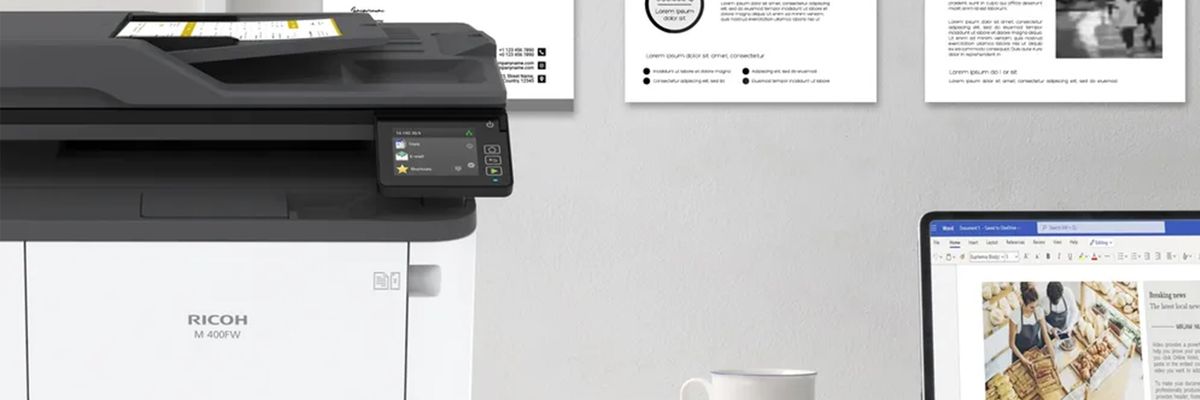
Choosing the right printing technology is not just about “putting ink on paper.” It is about ensuring consistency between physical and digital processes. When selecting a print format, organizations must connect it to their document management strategy. Printing sits at the center—it is often the starting point of digitization and, later, automation.
An Integrated Ecosystem: The Key to Doing More with Less
Mid-sized companies can no longer afford to manage too many vendors, platforms, support tools, or disconnected workflows. Complexity has become a silent enemy.
True transformation will not come from adding more technology, but from making technology work together: automation, security, devices, networks, collaboration, and information flows aligned within a single ecosystem. That is where Ricoh comes in. When this alignment happens, teams can focus on innovation—not on operations.